
Corporate events: beyond the conventional
Discover how to design memorable corporate experiences that reflect your brand's values and genuine essence.
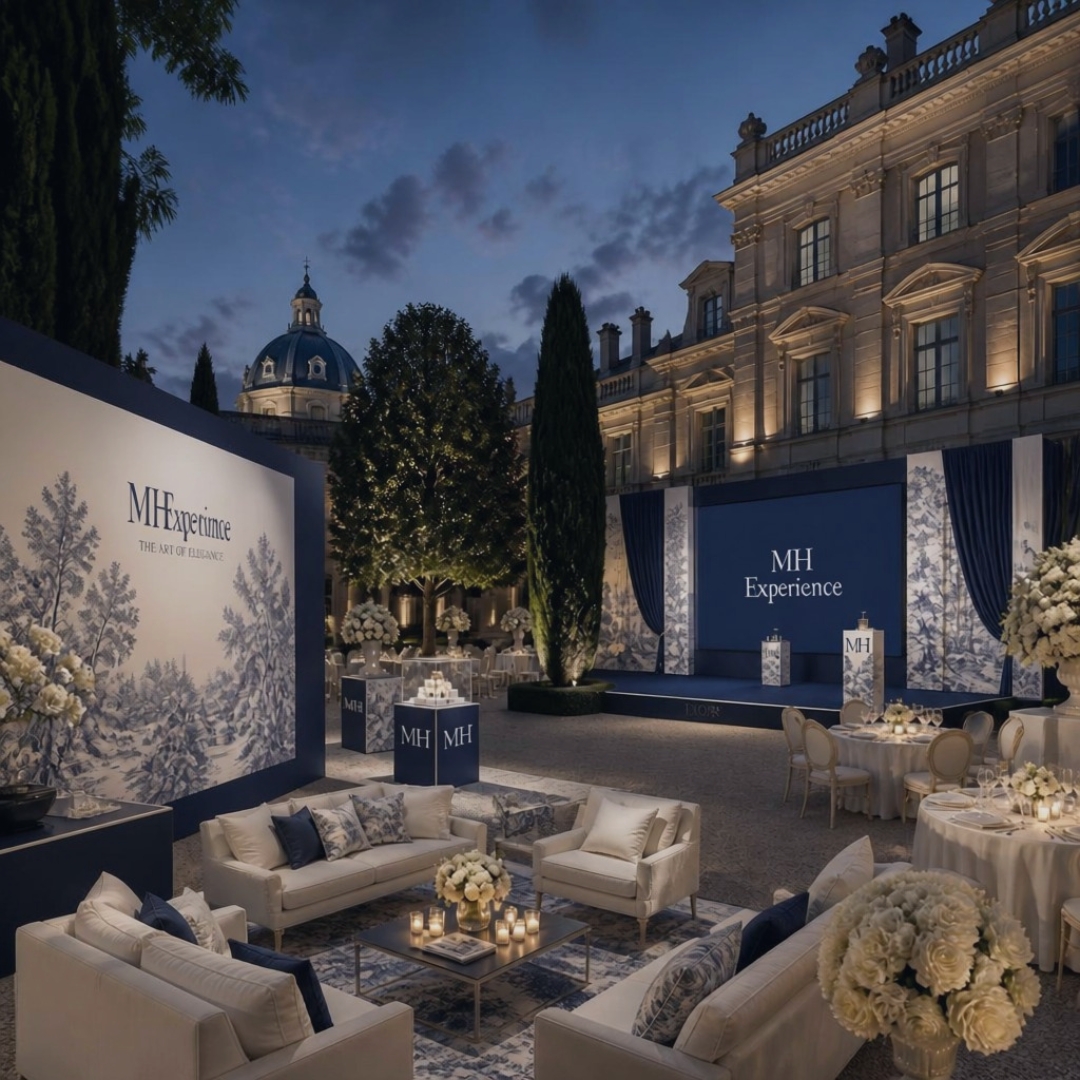
Corporate events often serve an operational function: bringing teams together, presenting a product or a vision, celebrating a milestone, or activating a conversation with current clients. Yet when an event is conceived solely as an exercise in convening people, its ability to leave a mark ends when the lights of the venue go out. What is memorable begins elsewhere: in the intention to turn a gathering into a tangible expression of what the brand believes, promises and aspires to represent.
In the current context, where audiences receive messages without interruption, physical presence is recovering a singular value. Not because people are gathered in the same place, but because it makes tangible what a digital campaign can hardly convey on its own: the tone of an organisation, the quality of its point of view, the way it treats those who accompany it, and the coherence between its narrative and its reality.
The data confirms that this expectation is strategic on a global level. Since 2024, an increase in budgets allocated to events for 2025 had already been forecast; in the most recent Global Meetings & Events Forecast by Amex GBT for 2026, 88% of respondents anticipated budget increases for the area1. At the same time, Cvent's global research among 1,650 professionals reveals a decisive shift in criteria: 63% place attendee engagement as their primary KPI.
In addition, another Amex GBT study3 highlights the top five priorities for professionals in this sector:
a] 33% consider improving the attendee experience through more memorable events a priority.
b] 31% indicate that data collection should improve, including the satisfaction level of attendees.
c] Unlike the 2024 survey, 30% reported a reduction in costs.
d] 28% mentioned improving or incorporating sustainability metrics.
e] 27% cited the incorporation of new technology.
“A high-value event is not defined by the spectacular nature of its resources, but by the precision with which it turns the essence of a brand into a shared experience.” - MH
The question, therefore, should no longer be what are we going to organise?, but what do we want people to understand, feel and remember about us when they leave?
From logistics to Brand Experience
Of course, logistics are essential to creating and executing a successful event, but they should never be the foundation or primary purpose of the brand. Coordinating timings, spaces, suppliers and technology ensures that an event works, but designing a brand experience ensures that it has an intention and meaning.
This distinction becomes especially relevant for organisations that compete through trust, reputation and perceived value. A corporate event is not a pause within the communication strategy: it is one of the few moments when a brand can be lived in its entirety, through all the senses and without the mediation of a screen.
This is not about giving up efficiency; it is about elevating it. Experiential design translates the corporate purpose into concrete decisions:from the chosen venue to the way guests are welcomed; from the pace of a presentation to gastronomic curation; from the quality of light to the subsequent gesture that prolongs the relationship. Every element communicates, even when it is not named.
Key differences
| Conventional Event | Corporate Experience |
|---|---|
| It is organised around an agenda. | It is designed from a brand intention. |
| It prioritises correct execution. | It unites operational excellence, narrative and emotion. |
| It treats attendees as an audience. | It recognises each guest as an active part of the story. |
| It measures attendance, punctuality and immediate satisfaction. | It observes connection, recall, conversation and relational value. |
| It ends when the programme ends. | It extends its meaning before, during and after the gathering. |
Memory is designed through coherence
In a purposeful corporate experience, the space is not a container and the programme is not a succession of blocks or a script; both are part of a narrative. Arrival should anticipate the brand universe; the welcome should express hospitality and the same values; content should provide a reason to pay attention; interaction should enable belonging; and the farewell should leave a feeling worth telling.
The Freeman Trust Report offers a significant sign of the scale of this opportunity. Among surveyed attendees, 95% said they trusted a brand more after participating in an in-person event. 92% stated that these gatherings positively influence their perception of the organisation, while 89% declared they felt closer to it4. These data invite a clear reading: proximity is not produced by accumulating stimuli, but by building a credible relationship.
For premium brands, this idea is even more decisive, because sophistication does not lie in adding elements for the sake of it, but in knowing what to include or omit and when to do so. A high-level experience is one in which no detail appears accidental and, at the same time, nothing feels forced.
“Curation is perceived in the balance between privacy and encounter, between surprise and clarity, between aspiration and authenticity.” - MH
Should technology disappear within the experience?
Technology expands possibilities, but it should not demand protagonism. It can facilitate a more personalised welcome, connect like-minded profiles, enrich content or help understand moments of greatest participation. Amex GBT identifies artificial intelligence as the main technology focus for 50% of meeting professionals, with anticipated uses in attendee matchmaking, content creation and interaction follow-up3.
So, how should it be applied? The key lies in using it discreetly.
In a high-value corporate experience, technology is effective when it makes everything simpler, more relevant and, above all, more human.If it becomes an autonomous spectacle, it competes with the story the brand should tell and, in worse cases, can even have the opposite effect and depersonalise the event.
If you have made it this far and still do not know how to create a memorable experience, here are some practical principles:
Five keys to designing corporate experiences that endure
1. Start with a brand truth
Every great event should be summarised in a phrase that belongs to no other company. Before choosing a format, it is necessary to define which value should become visible. Purpose-led innovation? Heritage and craftsmanship? A vision of the future? Executive proximity? Quiet excellence?
That truth will become a decision-making criterion. If the brand promises precision, the experience must express precision in its transitions, its attention and its language. If it defends innovation, it must allow the attendee to experience it, not merely hear or observe it. Coherence is, in this sense, the most elegant form of differentiation.
2. Design a journey, not just an agenda
The agenda informs; the journey transforms. Designing from the journey means considering the experience as an emotional sequence: expectation, discovery, participation, connection and resonance.
Freeman's report shows that 90% of consulted professionals value personalised content and experiences, and 92% want a variety of content and the ability to decide their own journey4. This does not demand ostentatious personalisation; it demands relevance. Offering interaction options, moments of pause, valuable conversations and content routes allows the guest's time to be treated as the asset it is.
The right question is not how much content fits into the programme, but how much value each person can truly gain.
3. Turn hospitality into a positioning gesture
Hospitality is one of the most powerful ways to speak about a brand without resorting to a speech. It is expressed in the welcome that anticipates a need, attention that does not intrude, gastronomy that supports the concept and the ability to make every guest feel expected.
In the corporate realm, hospitality should not be confused with protocol. Protocol orders; hospitality connects. Fluid access, a considered accreditation, a well-facilitated conversation or a carefully arranged table can express more about an organisation's standard than a statement of values on a screen.
4. Invite participation instead of asking people to observe
Experiences that are remembered do not place people in front of a brand, but inside it. This requires moving from exposure to exchange: conversations with leadership, demonstrations that involve, co-creation workshops, meaningful artistic interventions or networking moments that respond to shared interests.
Participation does not mean turning every moment into a dynamic; it means offering guests a real role. When a person can discover, contribute or share a perspective, they cease to be a recipient and become an active part of the encounter's meaning. It is then that the event can generate organic conversation and relational continuity.
5. Measure the imprint, not just attendance
Attendance confirms the level of attendance, but by no means confirms impact. A more strategic view combines quantitative metrics with qualitative signals: the quality of conversations generated, perceived closeness to the brand, intention of continuity, recommendation level, shared content, meetings opened after the event and memories that remain.
Freeman proposes complementing return on investment with return on objectives (Return on Objectives), incorporating dimensions such as awareness, satisfaction, retention and market expansion. For a brand, this approach is especially valuable because it allows the essential question to be answered: what changed in perception, relationship or conversation after people lived our experience?
Conclusion: what is lived also positions
The most powerful corporate events do not seek to impress for a few hours; they seek to shape a perception that continues afterwards in a conversation, a decision, a recommendation or the desire to become part of the brand again.
Therefore, going beyond the conventional does not mean producing more; it means designing with greater intention. It means understanding that strategy begins long before the invitation and that the experience does not end when the last speech concludes. It means making every gathering an act of coherence capable of bringing people, values and memory together in the same place.
At MH Experience we understand corporate events as emotional branding assets: settings where a company's identity becomes visible, perceptible and lasting. Because when a brand is lived authentically, it does not need to insist in order to be remembered.
“The most valuable corporate experience is not the one that occupies an agenda: it is the one that remains in perception.” — MH
Shall we design an experience that speaks for your brand?
If you would like to transform your next corporate gathering into an experience aligned with the essence, values and ambition of your brand, MH Experience would be delighted to talk with you.
References
- 1 Amex GBT Meetings & Events, 2025 Global Meetings and Events Forecast: meetings and events spend expected to increase in 2025, Oct 2024. [https://www.amexglobalbusinesstravel.com/press-releases/american-express-gbt-meetings-events-2025-global-meetings-and-events-spend-expected-to-increase-in-2025/]
- 2 Cvent, How Venue Sourcing is Changing in 2026: Data from 1659 Event Planners, Mar 2026. [https://www.cvent.com/en/blog/events/venue-sourcing-trends]
- 3 Amex GBT, 2026 Global Meetings and Events Forecast, Aug 2026. [https://explore.amexglobalbusinessmeetings.com/rs/346-POJ-129/images/ME-Forecast-2026.pdf]
- 4 Freeman and The Harris Poll, 2025 Freeman Trust Report, Feb 2025. [https://www.freeman.com/wp-content/uploads/sites/4/2025/02/Freeman_BrandTrust.pdf]
More articles
Back to Blog