
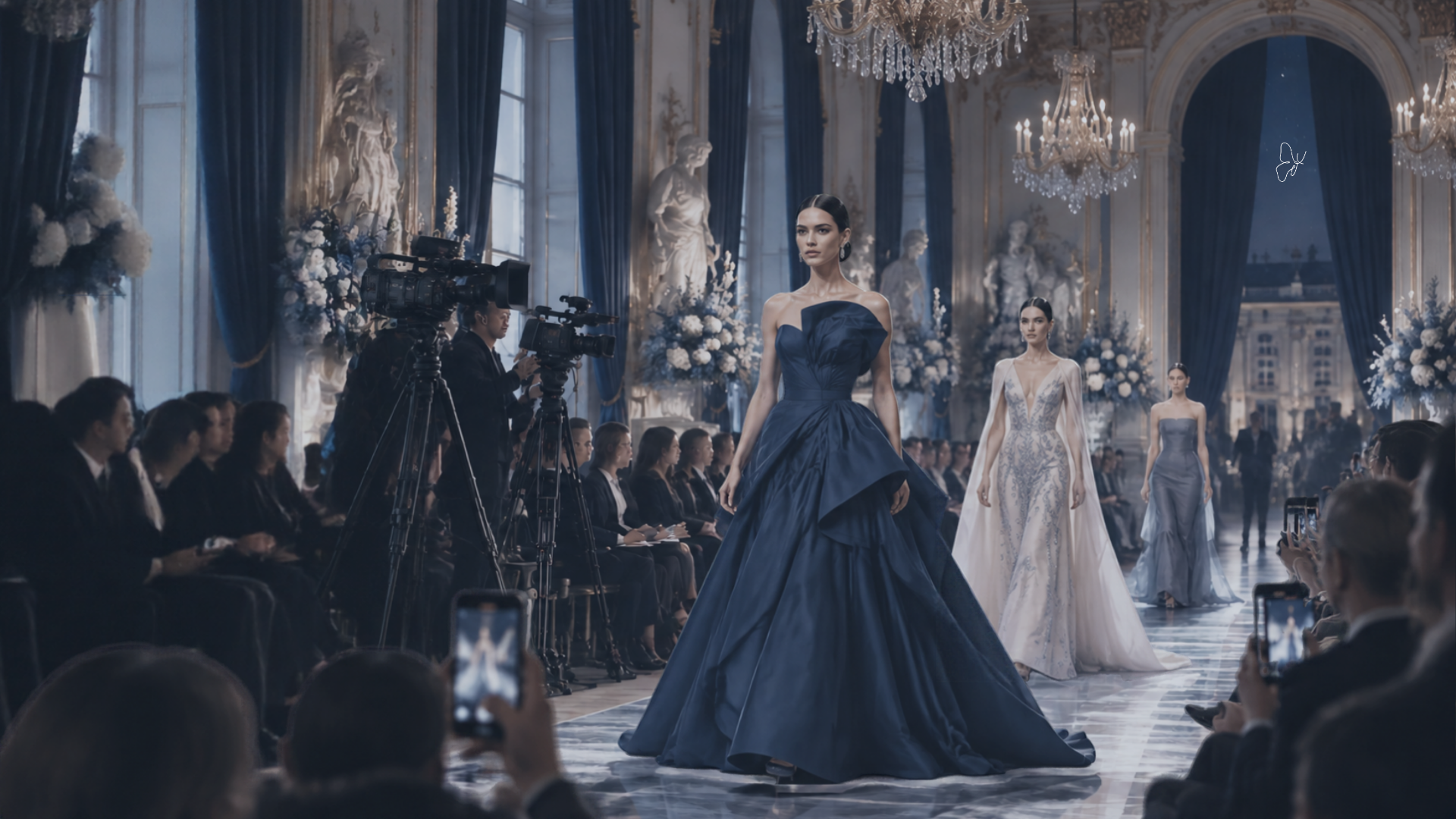
A fashion show lasts approximately twelve to fifteen minutes. In that interval, a fashion house concentrates a year of work, the authority of its atelier and a hypothesis about the future. No other luxury discipline condenses so much meaning in so little time, nor has changed the way it reaches its audience so profoundly over the past two decades.
In 1858, Charles Frederick Worth received his clients in a salon on rue de la Paix, Paris. In 2026, a haute couture collection can be watched live by millions of people from anywhere in the world, across a dozen platforms and in several languages at once. Between these two extremes lies more than a simple technological evolution: there is a redefinition of who may look, from where and with what right. The twenty-first-century runway is no longer only a place; it is a format.
This article offers a brief journey through the origins of the fashion show, the arrival of streaming in haute couture houses —with Dior and Chanel as paradigmatic cases— and the way this technology simultaneously strengthens and strains brand value. The final question is not technical but strategic: is technology a friend or an enemy of haute couture traditions?
The origin: an instrument of control, not display
The runway was not born to be seen by everyone; it was born to be seen by the right people. Charles Frederick Worth, regarded as the father of haute couture, founded the first Maison in 1858 at number 7 rue de la Paix in Paris, and moved fittings into the atelier: clients began coming to him rather than the other way around, establishing the salon tradition and its social staging from the first day. He is also credited with replacing mannequins with live models, including his own wife, to show creations in motion1.
In 1868, the Chambre Syndicale de la Couture was created, the organisation that ordered the trade and protected designers against copies. Almost a century later, on 23 January 1945, the designation “haute couture” was legally registered in France and reserved for houses approved every year by a commission under the Ministry of Industry2. Since then, haute couture collections have been presented twice a year: in January and July.
That private character had a foundational episode in the Lucile salon, the London house of Lady Duff Gordon, which at the beginning of the twentieth century turned dress presentations into a mannequin parade: restricted invitation, professional models, music and a silent choreography designed to awaken desire and prompt purchase3. In the United States, the idea travelled to department stores and, in 1903, the Ehrlich brothers staged in New York what would be considered the country’s first commercial fashion show4.
One detail deserves emphasis, because the digital era has made it visible once again: fashion-show visibility was always managed. For much of the twentieth century, photography inside couture salons was strictly restricted and accredited photographers worked under embargo, as houses feared pieces would be copied before clients and authorised manufacturers had placed their orders5. From the outset, the runway was an instrument for controlling access, time and image, not an open shop window.
The break in this format arrived in 1947, when Christian Dior presented his first collection —Corolle— and invited photographers who until then had been forbidden from entering private salons6. With that gesture, the fashion show became a media event.
International collection tours followed, as did Eleanor Lambert’s invention of New York press week in 1943 and, in 1973, the Battle of Versailles, where five French and five American designers competed on one stage: the first major staging of the fashion show as spectacle7.
Other designers of the century confirmed the trend: in March 1984, Thierry Mugler celebrated the tenth anniversary of his house with a show before six thousand spectators at the Zénith in Paris, including paying guests. It was the first time a collection had been presented as a great mass spectacle8.
The nineties also brought supermodels, global image campaigns and a format that, by then, had become a complete media product.
At every stage, houses expanded the number of witnesses, but retained a hierarchy: only a select few could be inside. The question for the twenty-first century is what happens when that “inside” stops being a physical place and becomes a screen within everyone’s reach.
The first digital crack (1998–2010)
The history of the broadcast fashion show is older than is often remembered. In 1998, Austrian designer Helmut Lang presented his collection through the internet and on CD-ROM. It was the first time a house chose to show its work without requiring physical presence9, yet it is important to stress that this decision was not an act of technological inclusion, but a statement about access.
In October 2009, Alexander McQueen and photographer Nick Knight broadcast Plato's Atlantis live from Paris through SHOWstudio: the first fashion show in history to be streamed10. Months later, in February 2010, London Fashion Week launched the first comprehensive digital calendar and Burberry became the first luxury brand to broadcast its show to a global audience11.
The British house later added experiments now familiar to us: looks sent to X (formerly Twitter) before reaching the runway, or its 2020 show on Twitch, with simultaneous viewing and live chat12.
By 2015, IMG was already recording 2.6 million people following New York Fashion Week live13. Yet resistance from some houses was real and has not disappeared completely. Many French houses remained sceptical for two enduring reasons: fear that copies and fast production would get ahead of the collection, and the loss of intimacy in a format built precisely upon it.
2020: the forced laboratory
With the arrival of the pandemic in 2019, many fashion shows were forced to cancel their presentations; however, it is important to stress that this event invented nothing, but forced the industry to use something that already existed.
In March 2020, Chanel cancelled its Capri cruise show, scheduled for 7 May, and that June presented the Cruise 2021 collection on its digital platforms14. That same year, Shanghai Fashion Week became the first fully digital edition, in partnership with Tmall: more than 150 houses broadcast their collections over several days with immediate purchase built in15.
Dior took the model to its highest point. Its cruise show in Lecce, held in July 2020 with reduced capacity, reached 30 million live viewers. Its Spring–Summer 2021 ready-to-wear show, broadcast in September, attracted 95 million live views on twelve platforms, 27 million of them from TikTok and Douyin alone. It also logged more than 115 million organic-content interactions, while #DiorSS21 was used 360 million times on the Chinese social network Weibo16.
Balenciaga, for its part, presented its Autumn 2021 collection as a video game: Afterworld: The Age of Tomorrow17, set in the year 2031.
In barely twelve months, the industry discovered three things at once: it could broadcast, it could measure and it could sell. This was when the fashion show ceased to be an event reserved for professionals and became a global communication asset. The question was no longer how to fill a room, but how to manage an audience.
The analysis
How technology supports brand value
- Scale: the arithmetic of the contemporary fashion show
A Dior show at the Grand Palais gathers around one thousand guests, but online it can exceed ninety million live viewers. The difference is not a quantitative detail but a change of category. Technology allows a collection to reach markets where the brand has no significant physical presence, so a haute couture house no longer depends on the geography of its audience. China is telling: Dior’s haute couture show was watched by more than eleven million people on Weibo18.
- The brand as a content platform
At Chanel, the fashion show is the origin of everything. Bruno Pavlovsky, president of its fashion division, has described it precisely: the creative team concentrates its energy on creating the event —set, music, collection— and that same team then produces the advertising, visual merchandising and window displays, ensuring coherence between the show and communication in every region19. When the show is broadcast, that master narrative becomes instantly exportable: the runway becomes the first chapter of the season, not its conclusion.
- Community: when the audience becomes a public again
The most interesting consequence of streaming is not how many people watch, but how they do so. In June 2025, critic Elias Medini —known as Lyas— was not invited to Jonathan Anderson’s first show for Dior Homme, so he chose to project the broadcast in a small Paris bar and invited his followers to join him. Nearly 300 people came.
In September 2025, with support from the British Fashion Council and other partners and sponsors, Lyas organised a tour of public screenings across London, Milan and Paris. At La Caserne, a former fire station in the French capital, he gathered more than 13,000 people in eight days. For Matthieu Blazy’s debut at Chanel, 3,000 people watched from that screening compared with the thousand inside the Grand Palais. The phenomenon generated 34 million impressions and an engagement rate thirteen times above the season’s average20.
The figure matters because it reverses the logic of passive streaming: the screen did not scatter the audience; it gathered it. In essence, it is the same function the salon served in 1900 —seeing together in order to desire together— performed with different infrastructure.
- Creative efficiency: artificial intelligence within the process
Artificial intelligence entered the fashion show through the workshop door, not the runway door. In the Autumn–Winter 2026 season, three clear positions coexisted: emerging houses using it as an operational and visualisation tool —mock-ups, moodboards, documentation, contracts— and describing its effect as an acceleration of the creative process; designers treating it as working material rather than a tool, even designing an entire collection from a quantum AI model; and creators explicitly rejecting it and defending aesthetic judgement, historical reading and emotion as irreducibly human21.
For a luxury house, the useful reading may be the first: AI as a tool for optimising time, freeing hours for what no machine can execute —embroidery, manual work, the final decision and judgement.
- Verification: the technology that protects value
There is one use of digital technology that has nothing to do with speculation and everything to do with defending value: certificates of authenticity, product passports and traceability systems already employed by houses such as Dior and Puma, or by Aura, the consortium of LVMH, Prada and Cartier22. In a category where copying has always been the primary risk, technology performs the function the couture syndicate performed in 1868: protecting authorship.
How it affects value: risks a live stream does not solve
1. The paradox of exclusivity
Luxury rests on a deliberate tension: being deeply desired by many and accessible to few. When the fashion show opens completely, the brand gains reach and risks the perception of rarity that sustains its price. This is why most houses do not choose between broadcasting and not broadcasting; they choose what to transmit and what to keep inside.
A professional broadcast costs between $6,500 and $100,000 per fashion show23, a minor investment compared with production costs —from six figures to more than a million at major houses, and no less than $350,000 for an independent house seeking top-level models24. The risk, then, is not economic but symbolic. A brand can be seen by millions and still lose authority if that visibility is not hierarchised.
2. The loss of narrative control
Broadcasting means yielding the frame. The most cited case is Dior in China: more than eleven million people watched its haute couture show on Weibo and the audience reaction was harsh, to the point that the episode became a case study in whether luxury takes streaming seriously or uses it as a simple shop window.
Live formats allow no corrections: a production failure, an unfortunate shot or a hostile reading in the chat become part of the house’s image in real time.
This has led to a trend that has consolidated in 2026: several houses —including Chanel, Schiaparelli and Iris van Herpen— have chosen to premiere professionally produced films after the physical show instead of broadcasting live, while others maintain the livestream. The decision is not technological but editorial: whoever controls the image controls the story.
3. Erosion through saturation
Any technology adopted without judgement trivialises the format it intended to elevate. The metaverse is the clearest precedent: the first Metaverse Fashion Week, held in Decentraland in 2022, gathered more than 100,000 visitors and created excessive expectations. By November 2024, the next edition passed almost unnoticed, digital collectibles had lost their value and brands redirected technology towards discreet, verifiable uses25.
The risk is now reproduced by AI-generated imagery: synthetic haute couture fashion shows circulate on platforms with the appearance of reality and compete for the same attention as real collections, without ever having passed through a workshop26.
4. The front row as a new battlefield
Digital audiences have also reordered prestige. Front rows, once occupied by critics and buyers, have filled with content creators and, in 2026, figures from the technology sector using the runway as a platform for their own narrative27.
The brand gains awareness, but without careful mediation it loses the kind of legitimacy only an expert gaze can produce. The strategic question is no longer who deserves a seat, but what conversation a house wants to generate from its fashion show.
Conclusion: is technology a friend or enemy of the great Maisons?
Framed as a dilemma, the question has no absolute answer. Technology is neither friend nor enemy of haute couture: it is a medium, and a medium is never neutral, yet neither is it sovereign. What decides its effect is what the house asks of it and allows it to do. Fashion-show history proves it: every time the industry expanded its audience —with photography in 1947, television and the internet in 1998, and streaming in 2020— the format survived because it did not confuse reach with meaning.
Three criteria emerge from that journey and should be upheld with discipline:
- 1. Live does not replace the fashion show. A collection’s authority is born in the room, in the encounter with the garment and in the presence of the atelier. Chanel has made this clear through an unusual decision: a €30 million commitment over five years to the Grand Palais cultural budget in exchange for the exclusive right to use the building for its fashion shows28. The house invests in physical spectacle precisely when technology would make it possible to do without it.
- 2. Distribution must be curated, not simply broadcast. Broadcasting everything is equivalent to editing nothing. The houses that best protect their value do not reject technology; they decide what piece is produced, with what edit and at what moment it is published29.
- 3. The audience must become a community. The phenomenon of collective screenings demonstrates a real demand for shared experience around a screen. Turning spectators into a community —with ritual, context and conversation— is the contemporary version of what the salon did with its clients.
There remains, however, a territory no broadcast can reach: the weight of a fabric hand-embroidered for four hundred hours, the temperature of a room before the first look, the gaze of someone discovering live what they did not know existed… That core is non-negotiable, and it is also haute couture’s strongest commercial argument: what cannot be transmitted is precisely what cannot be imitated.
The fashion show no longer ends at the edge of the runway; it ends wherever someone is watching. - MH
At MH Experience, we design brand experiences in which technology amplifies the ritual rather than replacing it. If your next fashion show, presentation or activation needs to travel further without losing its authority, let’s talk.
References
- 1 Fédération de la Haute Couture et de la Mode, Our history, Oct 2026 [ https://www.fhcm.paris/en/our-history ]
- 2 Zak, Emily (May 2020), Everything You Need To Know About The History Of The Fashion Show, Vogue UK. Oct 2026 [ https://www.vogue.co.uk/fashion/gallery/history-of-the-fashion-show ]
- 3 Evans, Caroline (2013), The Mechanical Smile: Modernism and the First Fashion Shows in France and America, 1900-1929, Yale University Press. Oct 2026.
- 4 White, Tom (Nov 2023), The Evolution of Fashion Week: A Historical Perspective, Fashion Week Daily. Oct 2026 [ https://fashionweekdaily.com/the-evolution-of-fashion-week-a-historical-perspective/ ]
- 5 fashion.at (Jul 2026), Haute Couture Week in Paris: Between Livestreams and Digital Control. Oct 2026 [ https://www.fashion.at/collections/2026/haute-couture-week-paris-2026-livestream-digital-shows-ip-protection6-7-2026.htm ]
- 6 Zak, Emily (May 2020), Everything You Need To Know About The History Of The Fashion Show, Vogue UK. Oct 2026 [ https://www.vogue.co.uk/fashion/gallery/history-of-the-fashion-show ]
- 7 Idem
- 8 Cleveland, Pat (May 2018), Pat Cleveland Remembers Being the Madonna in Thierry Mugler’s History-Making 1984 Show, Vogue. Oct 2026 [ https://www.vogue.com/article/met-gala-first-person-pat-cleveland-as-madonna-eighties-thierry-mugler-show-1984 ]
- 9 Socha, Miles (May 2020), Helmut Lang’s Online Show in March 1998, WWD. Oct 2026 [ https://wwd.com/fashion-news/fashion-features/feature/first-online-fashion-show-ever-helmut-lang-lessons-1203626257/ ]
- 10 SHOWstudio (Oct 2009), Plato's Atlantis. Oct 2026 [ https://www.showstudio.com/projects/platos_atlantis ]
- 11 Burberry (Sep 2020), Burberry is first luxury brand to partner with Twitch to livestream its fashion show. Oct 2026 [ https://www.burberryplc.com/news/corporate/2020/burberry-is-first-luxury-brand-to-partner-with-twitch-to-livestream ]
- 12 ídem
- 13 Flanelle Magazine (s.f.), Why Aren't All Fashion Shows Livestreamed? The Industry's Exclusivity Paradox. Oct 2026 [ https://flanellemag.com/why-arent-all-fashion-shows-livestreamed-the-industrys-exclusivity-paradox/ ]
- 14 Prant, Dara (Jun 2020), Chanel's Cruise 2021 Collection Brings Capri to Paris for Its First Digital Show. Oct 2026 [ https://fashionista.com/2020/06/chanel-cruise-2021-collection ]
- 15 Zha, Weixin (Apr 2020), Shanghai Fashion Week: The first entirely digital fashion week, FashionUnited. Oct 2026 [ https://fashionunited.uk/news/fashion/shanghai-fashion-week-the-first-entirely-digital-fashion-week/2020040648343 ]
- 16 Diderich, Joelle (Oct 2020), Dior Draws 95M Live Views for Spring 2021 Show, WWD. Oct 2026 [ https://wwd.com/fashion-news/fashion-scoops/dior-draws-95-million-live-views-for-spring-show-extinction-rebellion-1234619259/ ]
- 17 Ilchi, Layla (Dec 2020), What to know about Balenciaga’s Hybrid Video Game Fashion Show, WWD. Oct 2026 [ https://wwd.com/fashion-news/fashion-scoops/feature/balenciaga-video-game-fashion-show-fall-collection-1234669695/ ]
- 18 Williams, Gemma (Jan 2021), Dior's Failed China Livestream Is A Western Luxury Problem, Jing Daily. Oct 2026 [ https://jingdaily.com/posts/dior-china-livestream-fail ]
- 19 Doran, Sophie (s.f.), Do We Really Need The Fashion Show?, Luxury Society. Oct 2026 [ https://luxurysociety.com/en/do-we-really-need-the-fashion-show/ ]
- 20 Flanelle Magazine (s.f.), Why Aren't All Fashion Shows Livestreamed? The Industry's Exclusivity Paradox. Oct 2026 [ https://flanellemag.com/why-arent-all-fashion-shows-livestreamed-the-industrys-exclusivity-paradox/ ]
- 21 O’brian, Amy (March 2026), AI Has Officially Entered the Fashion Week Conversation, Vogue Business. Oct 2026 [ https://www.vogue.com/article/ai-has-officially-entered-the-fashion-week-conversation ]
- 22 Posse, Claudia (April 2025), What happened to the metaverse and NFTs in the fashion industry?, Garrigues. Oct 2026 [ https://blogip.garrigues.com/en/trademarks/what-happened-to-the-metaverse-and-nfts-in-the-fashion-industry ]
- 23 Flanelle Magazine (s.f.), Why Aren't All Fashion Shows Livestreamed? The Industry's Exclusivity Paradox. Oct 2026 [ https://flanellemag.com/why-arent-all-fashion-shows-livestreamed-the-industrys-exclusivity-paradox/ ]
- 24 Doran, Sophie (s.f.), Do We Really Need The Fashion Show?, Luxury Society. Oct 2026 [ https://luxurysociety.com/en/do-we-really-need-the-fashion-show/ ]
- 25 Posse, Claudia (April 2025), What happened to the metaverse and NFTs in the fashion industry?, Garrigues. Oct 2026 [ https://blogip.garrigues.com/en/trademarks/what-happened-to-the-metaverse-and-nfts-in-the-fashion-industry ]
- 26 O’brian, Amy (March 2026), AI Has Officially Entered the Fashion Week Conversation, Vogue Business. Oct 2026 [ https://www.vogue.com/article/ai-has-officially-entered-the-fashion-week-conversation ]
- 27 ídem
- 28 Modaes (Sep 2024), El legado continúa: Chanel vuelve a montar su pasarela en el Grand Palais de París. Oct 2026 [ https://www.modaes.com/look/el-legado-continua-chanel-vuelve-a-montar-su-pasarela-en-el-grand-palais-de-paris ]
- 29 Fashion.at (Jul 2026), Haute Couture Week in Paris: Between Livestreams and Digital Control. Oct 2026 [ https://www.fashion.at/collections/2026/haute-couture-week-paris-2026-livestream-digital-shows-ip-protection6-7-2026.htm ]